
Local economic vitality relies on both a strong workforce and a growing and productive business environment. To help gauge Johnson County’s economic progress and standing, our annual Data Digest report compares the county to eight peer counties across the country on thirty data measures. Within the business & labor category, four indicators provide insight into local economic conditions: unemployment rate, labor force participation rate, population to business ratio, and gross domestic product (GDP) per capita.
Together, these four measures place Johnson County in a competitive position among peer regions within the business and labor category. The county’s average ranking across all four indicators is #4 out of 9 peer counties, positioning Johnson County at the top of the middle tertile. Let’s dive further in to analyze the data trends Johnson County is experiencing among these key indicators.
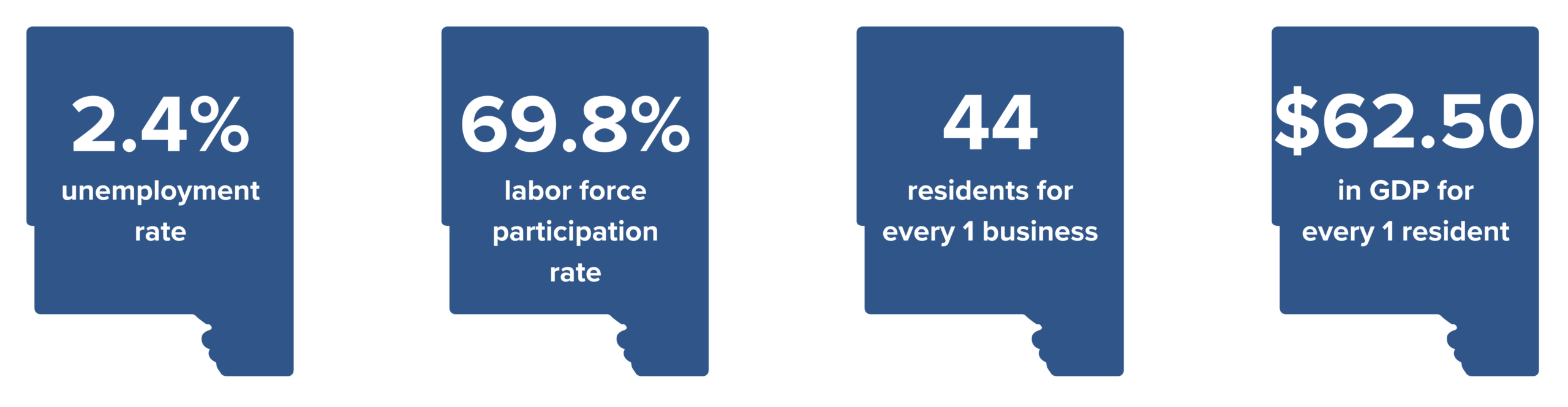
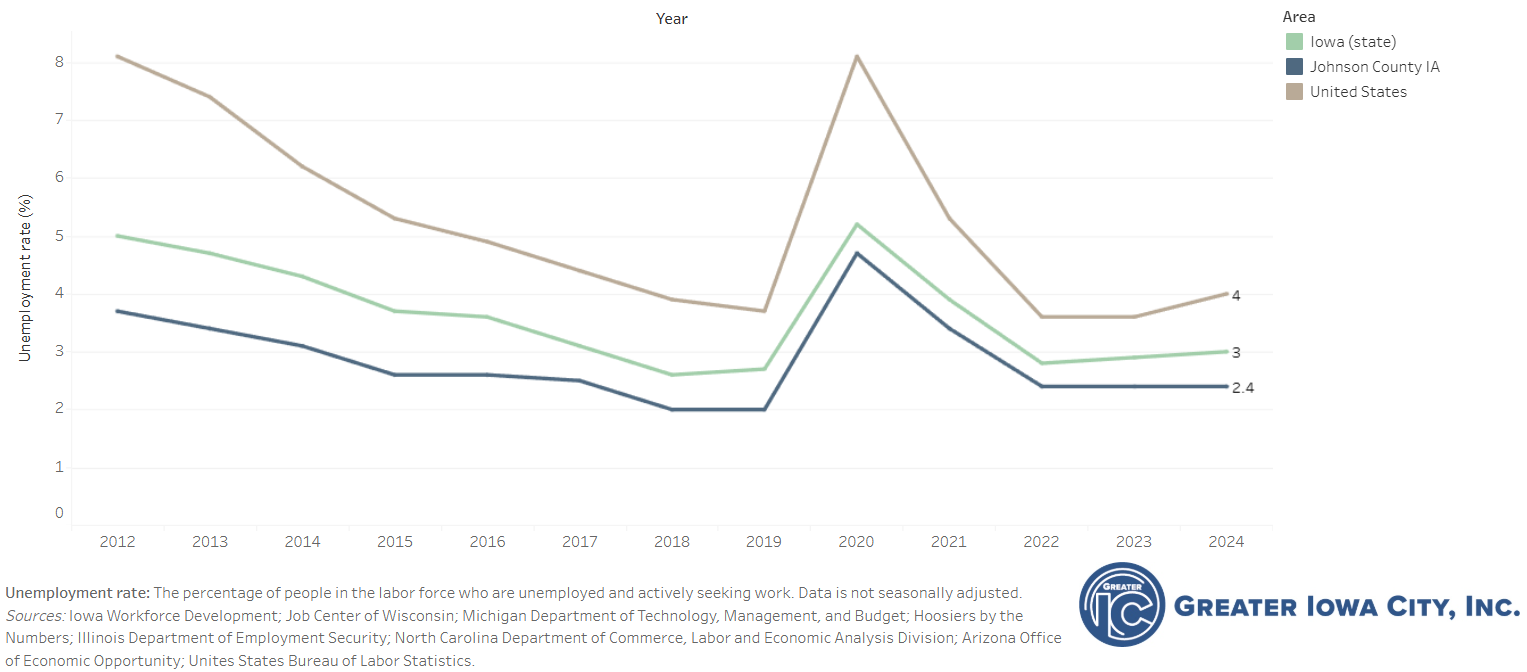
Johnson County’s unemployment rate (2.4% in 2024) and labor force participation rate (69.8% in 2023) are two of the area’s biggest strengths across all thirty metrics, and these strengths have sustained for over a decade. Our most recent data ranks the county at #3 in both measures, and, for the past ten years, the county has never fell beneath the top three threshold for either measure.
Data from our newly released Community Data Dashboard further shows that Johnson County’s unemployment rate continues to track below both Iowa and national averages. While local trends rise and fall alongside broader economic cycles, shown in the unemployment rate line chart below, the county’s consistently lower unemployment rate demonstrates labor market stability and strong employer demand. Our available data for both unemployment and labor force participation rate show that Johnson County is home to tens of thousands of residents who are active in the workforce and relatively employed.
While unemployment and labor force participation rate data emphasize the health of Johnson County’s residents in the workforce, our measures tracking population to businesses ratio and GDP per capita emphasize the employer side of the economic vitality formula.
Johnson County has maintained steady performance on the business side of the economy, but there are still many opportunities for growth. Johnson County ranks #5 in both businesses and GDP per capita, placing it in the middle of all comparison counties. In 2023, there were 44 businesses for every one county resident, totaling 3,490 establishments. These county establishments’ total gross domestic product was just above $9.6 billion in 2023, or $62,500 for every one county resident. While the county is in good standing for both measures compared to peer counties, the below ten-year trends give a different viewpoint to how these measures have changed in the past decade.
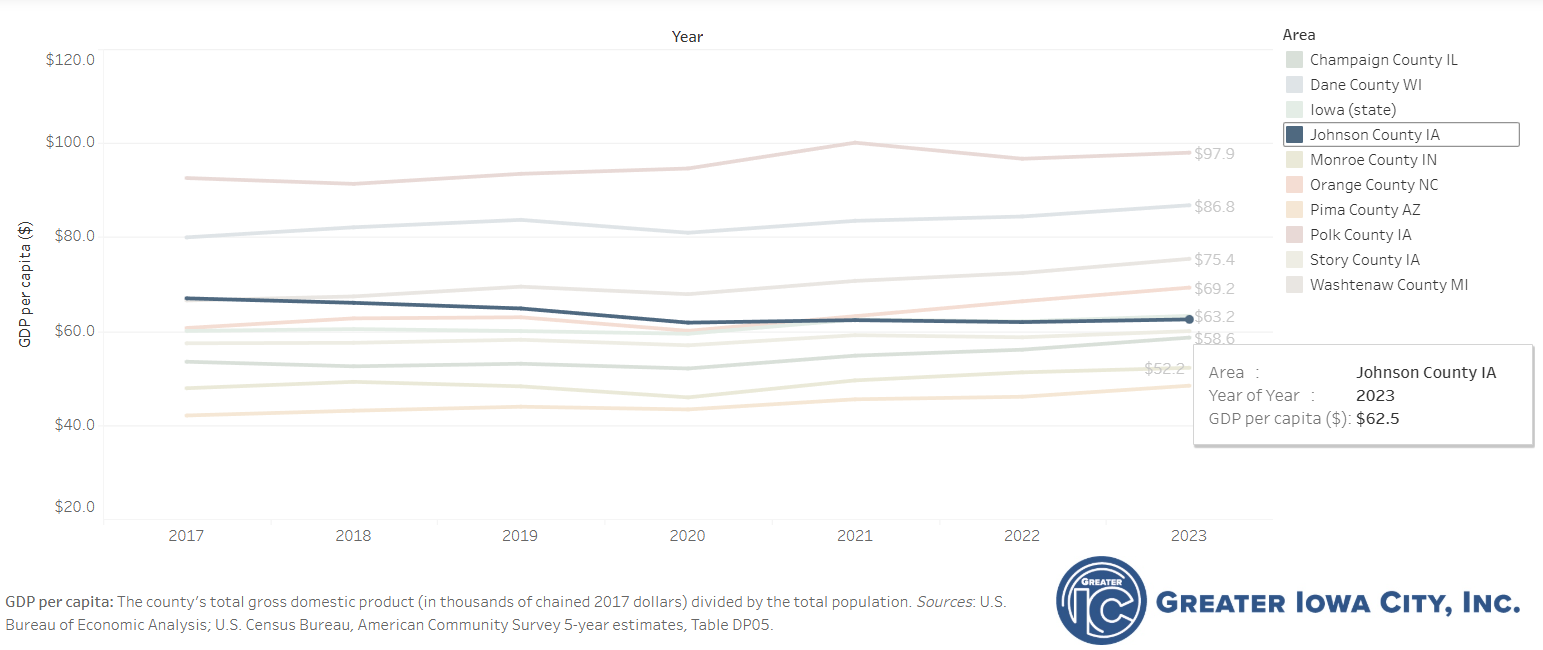
Long-term trends offer valuable context into how Johnson County’s economy continues to evolve. Between 2017 and 2023, the county added 192 new business establishments, signaling a slight increase in entrepreneurial and commercial activity. During that same period, though, total GDP increased by just $5.7 million. While this growth in total county GDP is positive, Johnson County’s rapid population expansion has outpaced said gains, resulting in a gradual yet noticeable decline in GDP per capita.
The GDP per capita line chart below highlights this shift across peer counties, Iowa, and the United States. Johnson County’s trend is spotlighted. Though the county is not at the bottom of the pack in terms of GDP per capita, and never has been, this line chart clearly visualizes that the Johnson County is the only county to have a downward trend in this metric.
Taken together, our four business & labor indicators show that Johnson County enters the coming years with strong workforce fundamentals, steady business activity, and clear data-informed opportunities for strategic economic growth. By continuing to support talent development, business expansion, and innovation, the region is well-positioned to strengthen economic output while maintaining its competitive advantages.
Explore our Community Data Dashboard >>>