
A well-connected and thriving region supports resident well-being through mobility, connectivity, and access to essential services. To assess how healthy and connected residents are across the greater Iowa City area, we turn to our Community Data Dashboard. Developed as a result of our annual Data Digest, our interactive tool tracks 30 business climate and quality-of-life indicators and compares Johnson County to eight peer counties nationwide.
While overall community health is a reflection of multiple interconnected factors like financial security, social connections, and environmental conditions, our health & transportation category targets four core measures: access to mental health services, health insurance coverage, food security, and commute time. Together, these indicators offer insight into how residents move through and experience the region.
Across all four measures, Johnson County performs strongly relative to its peers. The county ranks in the top three for both food security and commute time and falls within the middle tertile among all counties for mental health access and health insurance coverage. Notably, Johnson County does not rank in the bottom tertile for any measure, though some emerging trends warrant continued attention.
Transportation
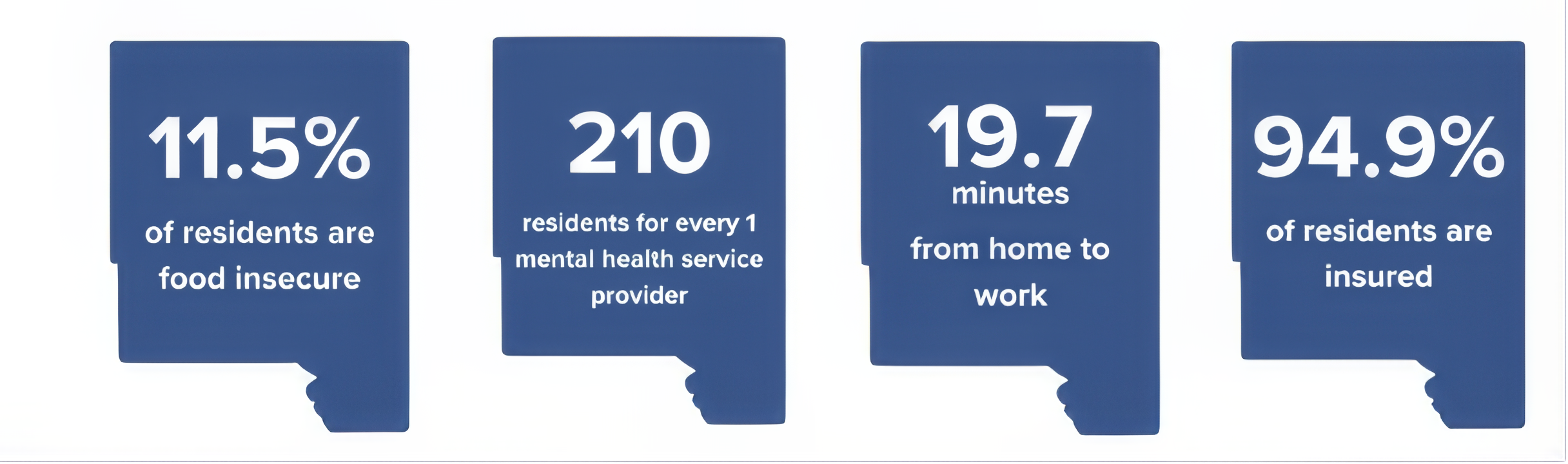
Johnson County boasts an average commute time of 19.7 minutes, besting the national average by nearly seven minutes. Several factors contribute to this efficiency. The county’s contiguous metropolitan layout and strong interstate and local road network allow residents to reach their workplaces quickly.
Transportation choices amongst residents that are employed further support a short commute time. More than 12,000 residents walk, bike, use public transit, or rely on non-vehicle modes to commute (2024 ACS 5-Year Estimates, Table DP05). The high usage of active transportation and public transit suggesting that many workers live close to their jobs. This is partially proved by our living and employed in county measure. Two of every three Johnson County residents who are employed also work in the county, showing a very strong local retention rate. In addition, the county and its cities continue to expand a robust trail system, increasing access to active and healthy transportation options.
Health
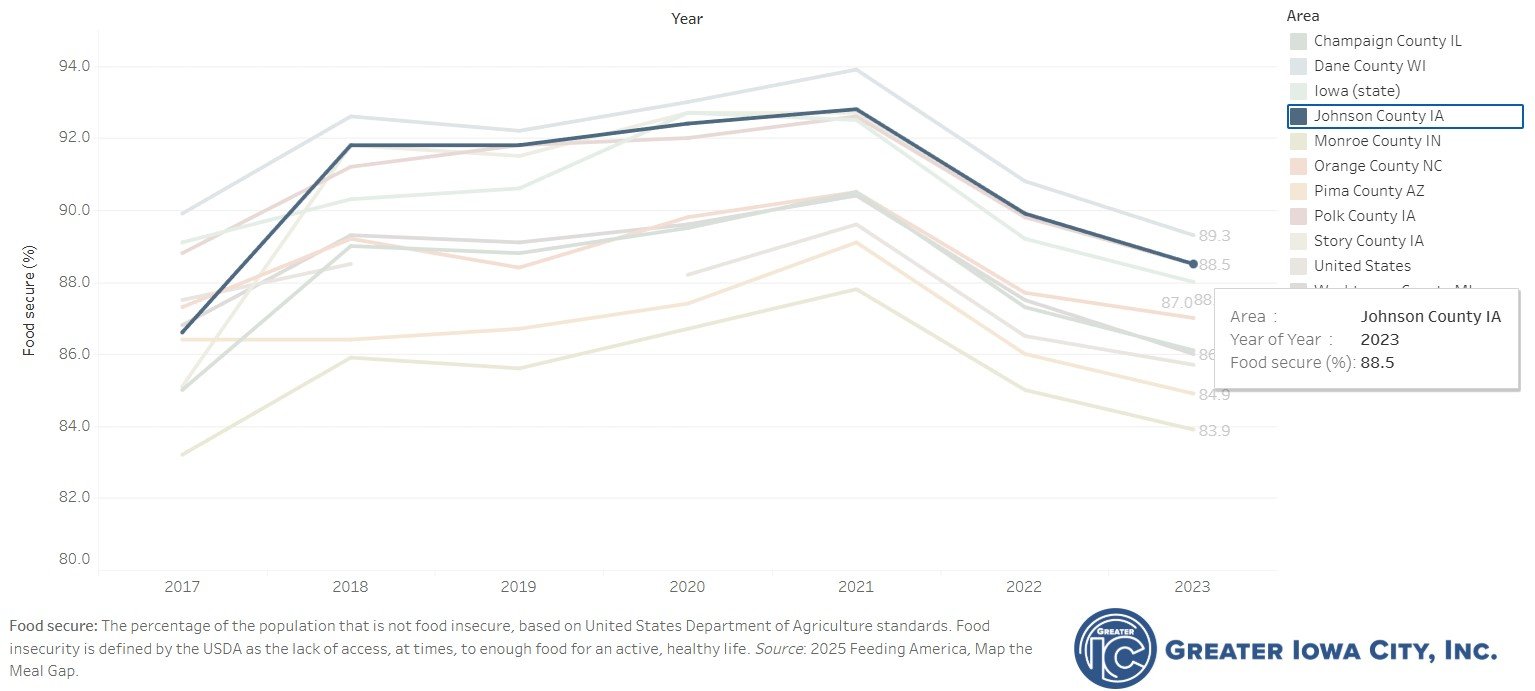
Food security trends highlight a growing challenge nationwide and Johnson County’s recent data reflects this shift. After increasing steadily since 2017, the share of food-secure residents began to decline in 2021. In 2023, 88.5% of Johnson County residents were food secure, down from a seven-year peak of 92.8% just two years prior in 2021. As food insecurity rises, local organizations have responded by expanding pantry services and strengthening collaborative efforts, as the Johnson County Food Access Network exemplifies.
Food security and transportation patterns serve as important social determinants of health, but the Community Data Dashboard also tracks direct access to care through mental health services and health insurance coverage. Johnson County has an array of diverse health services complimented by highly advanced manufacturing and research facilities. Altogether, the healthcare ecosystem is strong. Markedly, the area is home to University of Iowa Health Care (UIHC), the largest medical provider in Iowa. Recently, UIHC’s expanding reach, alongside other local providers, has provided residents close access to a wide range of services, including mental health care.
For the past decade, Johnson County has ranked #4 among peer counties in mental health providers per capita. In 2024, the county averaged one provider for every 210 residents. It is noteworthy that Johnson County’s per capita measure of mental health providers is decreasing even when considering the county’s rapid population growth. In other terms, the number of new mental health providers is growing at the quicker rate in the past ten years than the population has grown.
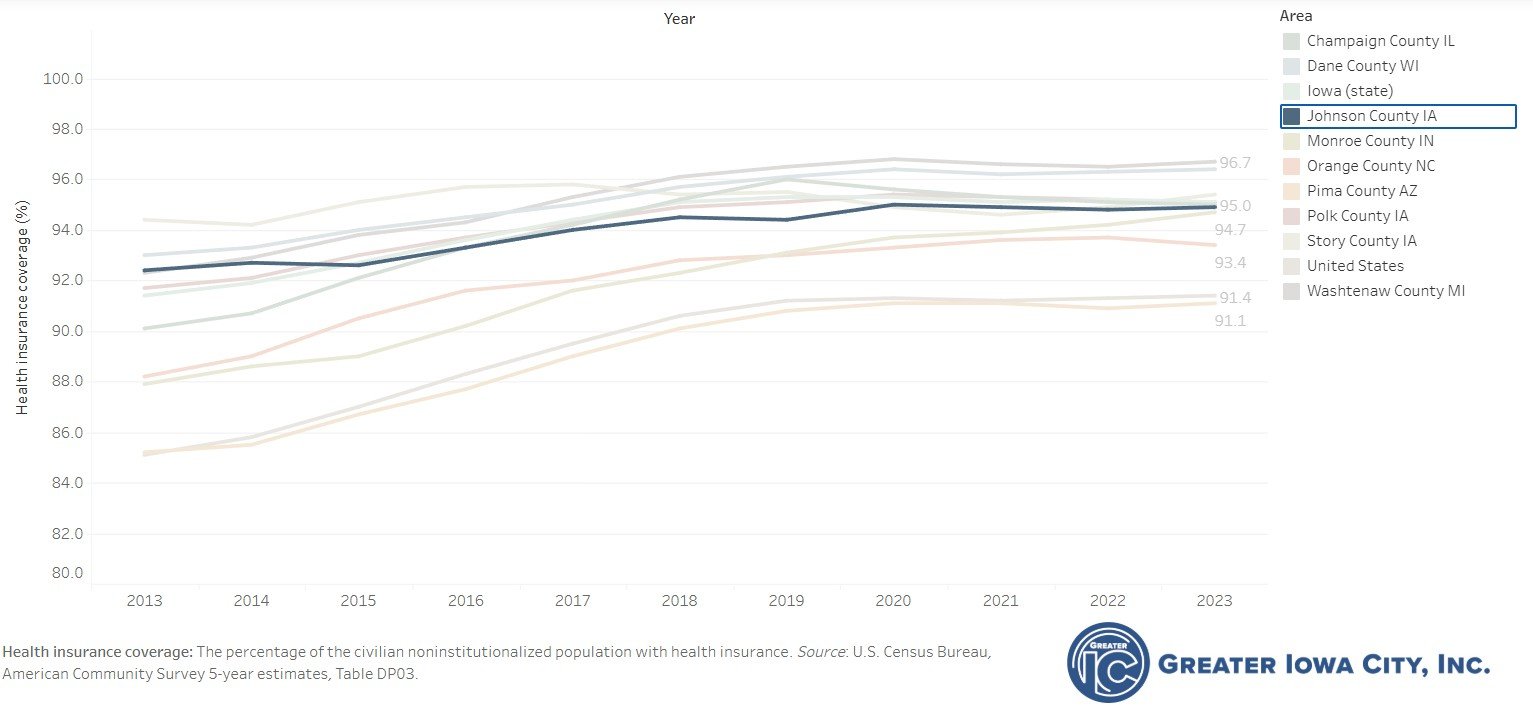
Financial access also shapes health outcomes. In the medical world, financial access often comes in the form of health insurance. While Johnson County increased its health insurance coverage from 92.4% in 2013 to 94.9% in 2023, its relative standing among peer counties has shifted. Once ranking #3, the county now ranks #6, as other counties have expanded coverage more rapidly. Washtenaw County, MI, and Dane County, WI (home to the University of Michigan and the University of Wisconsin) now exceed 96% coverage. As local health care services continue to grow, sustaining and accelerating insurance coverage will remain essential to supporting a healthy population.
A healthy community remains a cornerstone of long-term regional success. Johnson County’s health & transportation data at the Community Data Dashboard point to strong foundations while also identifying areas for continued focus. By utilizing these insights, we can reinforce what is working well and strategically address emerging challenges.
Explore our Community Data Dashboard >>>