Greater Iowa City, Inc.’s Community Composition and Opportunity data provide a look into the diversity of Johnson County’s population and opportunities for upward economic mobility. As Greater IC continues to work towards creating a thriving, inclusive economic ecosystem throughout Johnson County, collecting and analyzing appropriate data remains an essential part of the process.
In 2024 and 2025, Johnson County entities, organizations, and businesses made deliberate efforts to support underestimated populations throughout the county. In 2024, the Underestimated Small Business Grant program was launched, and over 400,000 dollars were awarded to small business owners. Then, in 2025, Johnson County gained a distinct Certified Welcoming status, which is a designation for local governments that have created practices reflecting their values and commitment to immigrant inclusion. These programs and initiatives, alongside numerous others happening right here in Johnson County, did not happen by accident. They stemmed from a variety of recommendations included in the Inclusive Economic Development Plan for Johnson County, created in late 2022.
The data included in the plan, along with the data continuously tracked by Greater IC in our Community Data Dashboard, guide new investments in our community that contribute to the economic successes and upward mobility for all residents throughout the county.
Analyzing Johnson County’s Population Diversity and Upward Opportunities
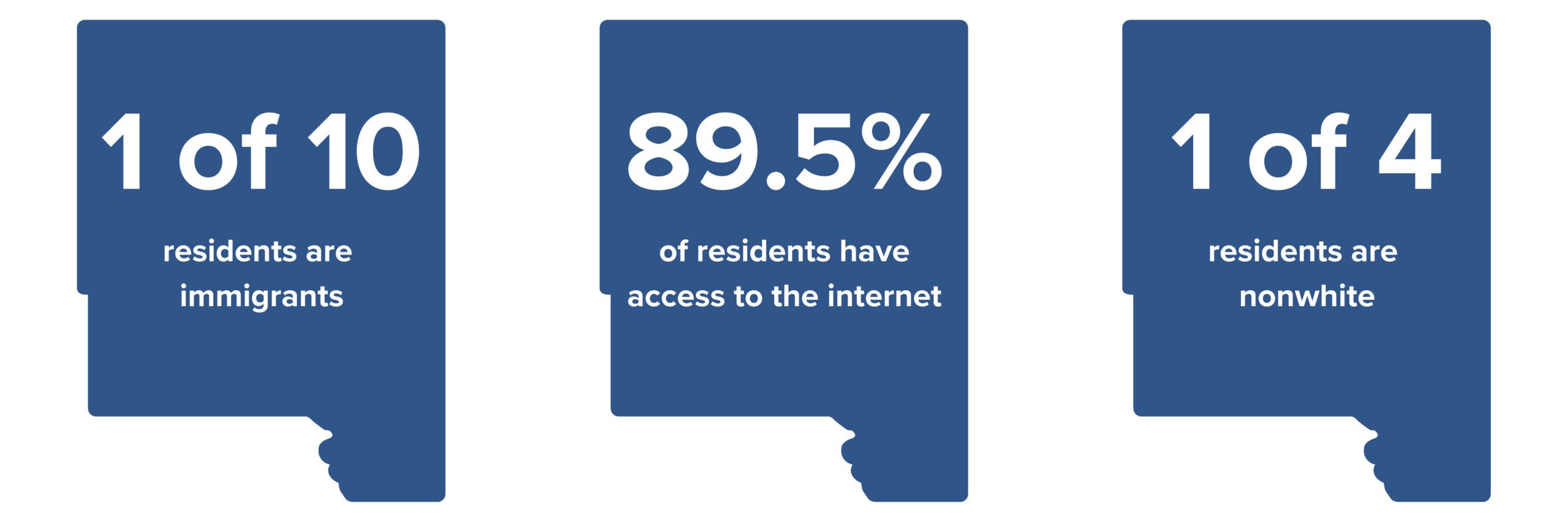
In 2023, 75% of the county population was identified as white alone. In other words, exactly one of every four residents throughout Johnson County was nonwhite. Since 2016, the share of nonwhite residents in the county has increased by over five percentage points. This trend and demographic shift are not unique to the Iowa City area, as many counties across both Iowa and the United States have experienced a similar increase in racial diversity. Among all eight of the comparison counties included in our Community Data Dashboard, only Polk County, Iowa, and Champaign County, Illinois, experienced a larger increase in the share of nonwhite residents.
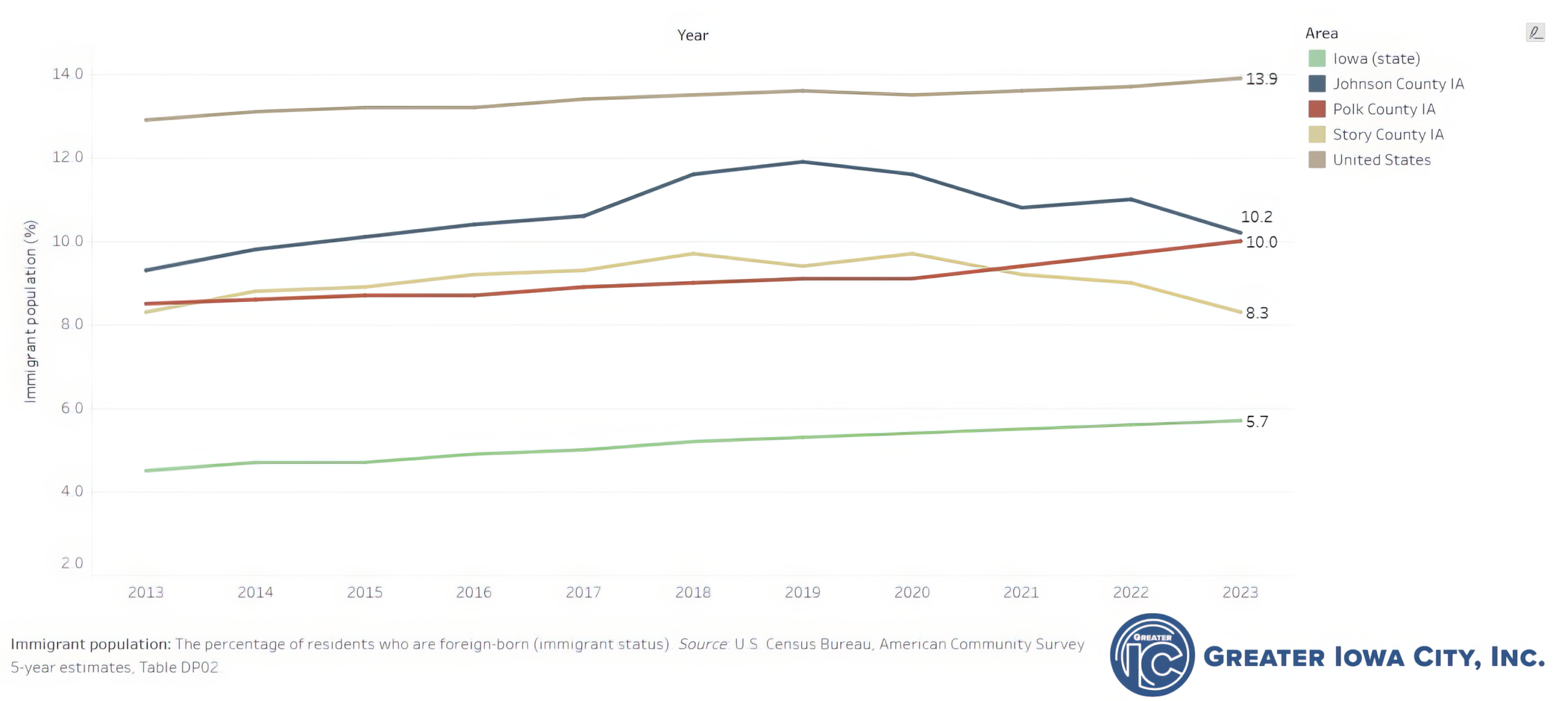
As Johnson County’s Certified Welcoming designation reflects, Johnson County has a relatively large share of immigrant residents who call the greater Iowa City area home. In 2023, one of every ten county residents was born outside of the United States, totaling 10.2% of the population. Over 15,000 residents in Johnson County are immigrants. Of all cities and towns in the county, Coralville has the highest share of immigrant residents with over 15% born outside of the United States. Though over 10% of the county’s residents are immigrants, the total share has decreased by almost two percentage points since reaching its peak at 11.9% in 2019.
A supplemental data point to foreign-born residents is language spoken at home. While just 10% of the county’s residents are immigrants, 14.9% of residents speak a language other than English at home. This metric is supported by Johnson County’s largest school district, the Iowa City Community School District, where students speaks over 60 languages and more than 20% speak a language other than English at home.
The county’s economic, community, and social partners will continue to explore new ways to support all immigrant residents whose contributions enrich our social, cultural, and economic lives.
Opportunities for upward mobility can come through education and access to resources. Johnson County has some of the best educational resources in the entire state. Our county is home to the top-ranked high school in the state, three of the top ten high schools in the state, and four of the top 15 high schools in the state. And, our county is home to both the University of Iowa and Kirkwood Community College, providing access to both higher education and workforce training and apprenticeship programs.
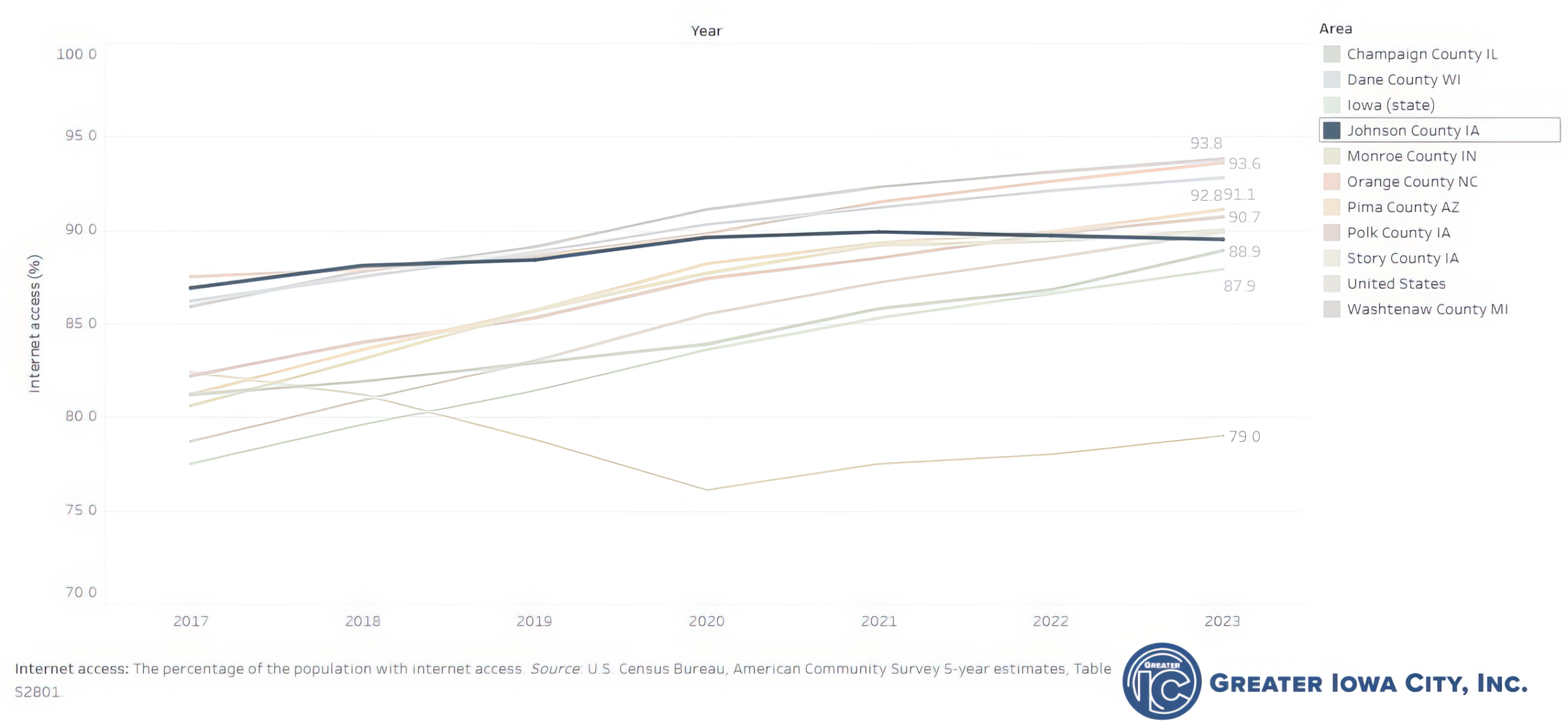
A successful education depends on proper access to services and digital infrastructure, an area that needs improved throughout Johnson County. In 2023, just 89.5% of county residents had internet access at home, lower than the national average but just higher than the state average. Of note, Johnson County is the only county in the dashboard whose internet access percentage has decreased since 2020.
Internal Greater IC data also indicates that the share of households with broadband and computer access at home has decreased from 2020-2024, while the state and national averages for this metric have both increased by over five percentage points. This suggests that the digital infrastructure has not kept up with the county’s population growth in the past four years of available data.
Improving the digital infrastructure throughout the county is vital to upward mobility and future success. While that infrastructure gets built over the years to come, many local libraries offer mobile Wi-Fi hotspots and free Wi-Fi on site to fill the connectivity gap.
For more information and to see how Johnson County compares relative to other communities, please see our 2025 Data Digest report and our interactive Community Data Dashboard.
Explore our Community Data Dashboard >>>
Read our 2025 Data Digest Report >>>
Want to learn more about Greater IC’s data services? Reach out to Evan Doyle, Economic Development Program Director (evan@greateriowacity.com) for more information or data requests.